Sunday, 24 February 2013

Dystopian YA endings: too dark, or not dark enough?

by Teri Terry, 
on special leave from the Writing Cave
"...genre is just a flavouring. It's not the whole meal. Don't get confused by the scenery."  Terry Practchett, 2001 Carnegie speech

When I'd barely begun writing Slated, I kept getting asked: what is it about? What genre box to we put it in? I struggled to answer this when the story was still forming, but would usually say something about it being a future society where criminal young people have their memories stolen. What I frequently heard back was this: that is dystopian.

So...what does 'dystopian' mean? Back then I'll admit I only had a faint idea. I felt I knew what a utopia was: an imagined perfect society. A dystopia was somehow the opposite, defined by the absence of perfection. Since that time I've read many dystopian novels and recently finished a research MA on dystopian YA fiction, so you might think I've got a grasp of what it is meant to be, and how the Slated trilogy fits (or doesn't) in the dystopian box.

What comes next? For many weeks now I've been hiding away in the Writing Cave*, working hard on the third and final instalment of the Slated trilogy (the second, Fractured, is out soon: April in the UK/Australia; September US/Canada).
     *Writing Cave: a lonely place containing one badly dressed author under threat of deadlines, half drunk cold cups of tea, and empty chocolate wrappers. Often in desperate need of dusting.
Confession time: Should I admit that over half way through the first draft that not only have I not named book 3, I also haven't entirely decided how it is going to end? (please don't alarm my publishers by telling them this!). 

As a writer I like to not know everything about what is going to happen as I write. This is the excitement of writing: waiting for the characters to demand what happens next in ways that surprise. It is also the terror...
Has spending too much time on the academic side of things thrown down a gauntlet for the ending of the Slated trilogy?
Before the YA craze, dystopian novels had a specific function. They are set in a future society where things are going horribly wrong; somebody, our hero, fights against the system, but ultimately, tragically fails. The whole point is that of a lesson, a call to action: change the world now, or this may happen. 

The YA crowd of novels are different: endings are often hopeful, ambiguous rather than miserable, or even happy. Literary critics don't like the departures, say the way they end means they aren't really 'dystopian'. And at the same time there are those that argue the entire genre of YA dystopians are too dark, too depressing.

Having had my head under these academic arguments for too long (way WAY too long...!) it is easy to see the end of my trilogy as something that either comes out on one side of this, or the other.

But getting back to the quote from Terry Practchett: genre boxes can serve useful functions. They help booksellers and librarians know where books fit on their shelves; they help readers make reading choices. But I need to remind myself as a writer that they aren't the whole meal.
Ultimately it is all about this book, this story, and where all the characters yammering away in my head want to go. And the story always wins for me.
Terry Practchett's full Carnegie speech can be found here. I'm really excited that we're both up for the Rotherham Book Award: fingers crossed he is there! Though I may be embarrassingly fangirling if he is.

Monday, 11 February 2013

Dark, Disturbing and Addictive - Tanya Byrne reveals her writing process for Heart-Shaped Bruise

By Claire Merle

Heart-Shaped Bruise by Tanya Byrne breaks the rules, drawing us into a psychologically compelling story where the protagonist is the villain. As an author, I am as intrigued by Tanya Byrne's writing process as her disturbed narrator Emily Koll. Today, I have the huge pleasure of welcoming Tanya to Demention to answer some probing questions about how Emily Koll emerged, how the voice and shape of the story took form, and how Tanya managed to create such empathy for a character that is essentially 'unlikeable'. 

Hi Tanya, thank you so much for joining us here on Demention. How would you describe Heart-shaped Bruise in just a few words to someone who hasn’t heard of it before? 

Heart-Shaped Bruise is the story of Emily Koll, Archway young offenders institution's most notorious inmate. Last year, the psychiatric unit is closed and Emily's journal is found on top of one of the wardrobes. In it, Emily explains why she did what she did and why she isn't sorry at all.

I read in an interview that you originally wrote the book from Juliet’s point of view, a teenager going into Witness Protection, and that Emily Koll wasn’t introduced as a character until you were working on a second draft. Once you took the leap and began rewriting the story from Emily’s perspective, how well did you know her as a character already? How much did the story change once she was telling it? Were there any big surprises?

I don't know where Emily came from. I wish I had a romantic anecdote about a dream or a girl on the bus, but all I can say is that one moment she was there, and there she wasn't. She's the one character in Heart-Shaped Bruise that I didn't question or fret over, she just was. I knew her take on events would be riveting, but I'd written a whole novel from Juliet's point of view and was reluctant to throw away all of those words, so in the second draft I alternated their POVs. I got about 40k in and realised that it was Emily's chapters I looked forward to writing the most, she made me laugh and scared me a little. Writing villains are so much fun because you can push them so much further and I really pushed Emily. I knew that I had to start again but the thought of doing all of that work again was unbearable. A friend convinced me not to, saying that no one would read a book from the villain's point of view, especially a debut. But I'm a contrary so-and-so, so as soon as she said that, I started again, determined to prove her wrong. I hope I have. In the end, it was surprisingly easy. I finished Emily's draft in three months and it was an utter joy to write. I knew then that I'd made the right decision.

Using a diary format is a very effective way of unfolding the story, and also preparing the reader to accept what Emily does. How did you come about this decision and how conscious was it?

I had to use a diary format, because the whole point of the book is Emily setting the record straight. I considered doing this in a series of newspaper articles and police interviews, but they wouldn't be as honest, as vulnerable. As Emily says in her first entry, she leaves pieces of herself all over London. She tells her psychiatrist, Doctor Gilyard, some things, her friends at Archway some things. She scratches things into walls, writes on the back of receipts, but the journal is the only place she keeps everything.

At what stage in the writing process did you decide to set a Heart-Shaped Bruise in a young offenders’ institution and how did this alter the tone and feel of the book? Was it a decision you felt immediately comfortable with or an idea you played around with before committing?

I knew I wanted to tell the story backwards, so it had to be set at Archway. If it started the day she was released, or during her trial, or even the day she finds out who her father really is, it would have been a completely different book. Any of those stories would have been compelling, but there's was something about Archway, about the inmates and the routine and the claustrophobia, that was a thrill to write after writing Juliet's point of view, which was much more 'normal' and included going to college and being at home and snogging her boyfriend.

I actually grew up in a little side street off Archway Road between Highgate and Archway. (Sorry had to slip that in – small world and all that!) I was curious, why Archway and why invent a fictional young offenders’ institution rather that one that already exists?

I hope it feels authentic! When my mother first moved to this country, she used to work around there - as a nurse at the Whittington Hospital - and my brother is an Arsenal fan, so when picking a location, it seemed obvious. There aren't many female young offenders institutions and I wanted to avoid comparisons with an existing one, so I made one up, which gave me much more freedom.

You have an unreliable narrator who has done bad things and technically isn’t that likable. But you manage to create great empathy with her and a sense that she is carried along by a tide she cannot really control. Can you give us any clues as to how you managed that?

Thank you! I guess I just tried to make her human. Actually, not make her human, rather show her to be human, which is. I think the most unsettling thing about Heart-Shaped Bruise is that you wonder, with the right people around her and enough support, if Emily would have done any of the things she did. That was the question I was trying to ask with this book, if we're all a couple of bad decisions away from doing similar.

The reader is drawn through the story by a strange compulsion to know what it is, exactly, that Emily has done to get her locked up in the psychiatric ward of a young offenders’ institution. When you wrote your first draft from Emily’s perspective did you know what she’d done and how the story would end?

Absolutely. It's the same story, but in Juliet's draft I told the story forwards and in Emily's, I tell it backwards. I think that's common for most writers; we know how a story begins and ends, it's just that annoying bit in the middle!

Do you have a favourite line or scene from Heart-shaped Bruise and if so, can you share it with us?

My favourite chapter, and the one I read out at events, if my emotions will allow it, is the scene where Emily burns Juliet's photo. It's such a despicable thing to do, and Emily knows it. She knows that's the point of no return and it broke my heart to write.


Thank you so much Tanya for joining us. For all of you out there searching for a book with a powerful voice, intriguing narrator and an addictive, provocative read, I highly recommend you get your hands on a copy!

LINK UP WITH TANYA HERE

They say I'm evil. The police. The newspapers. The girls from school who shake their heads on the six o’clock news and say they always knew there was something not quite right about me. And everyone believes it. Including you. But you don't know. You don't know who I used to be. 

Who I could have been.

Awaiting trial at Archway Young Offenders Institution, Emily Koll is going to tell her side of the story for the first time. 

Heart-Shaped Bruise is a compulsive and moving novel about infamy, identity and how far a person might go to seek revenge.

Monday, 4 February 2013

I like Billy Joel – A Review of Maggot Moon by Sally Gardner - Reviewed by Julienne Durber

I like Billy Joel.  There, I've said it.  The music of the multi award winning, rock and roll hall of fame member who wrote such popular tunes as Uptown Girl, Piano Man and Just The Way You Are makes me happy.

A piano, man
So what?  Some of you are undoubtedly thinking.  He's all right.
Really?  Billy Joel?  Others may be sniggering behind your hands.
What has this got to do with Maggot Moon?  Many more may be shouting.

Me
As you can see, I'm a long-haired guy who's quite fond of purple.  When I'm not writing I sing and play guitar in a rock band.  My iTunes is crammed with Muse, Metallica, The Killers, System of a Down, Kaiser Chiefs … you get the idea.  Piano-based rock and roll pop from the 70s and early 80s should be something I hate.  But it's not.  I like it, and that's that.

Now when a friend whose opinion I respect greatly in all matters literary told me I should definitely read Maggot Moon, I bought it straight away without even looking at it (we were standing near a book stall at the time), shoved it into my rucksack and went on with my day.

A week later I pulled it out and read the jacket notes, wondering what it was actually about.  First off is a quote from the wonderful Meg Rosoff
'Dazzling, chilling, breathtaking.  A perfect book.'
High praise indeed, but what's it about?
Hector and Standish are friends.
Nice.  I like odd names.  I own one myself.
It then goes on, and this is where the alarm bells started to ring.
… live together in Zone Seven … the Motherland can keep them … under surveillance … moon landing …
And finishes with
A powerfully original and moving story.
We'll see …

Without giving anything away, the main aspect of the setting and a key element of the plot are concepts that I've seen explored before … a lot.  The BBC have produced plays about the events that Gardner is hinting lead to the dominance of the Motherland.  Sci-fi comic stories and time travel shorts have mused on what would have happened if … And I even remember a sketch on the Two Ronnies show in the 70s that featured a similar set up.  There are documentaries and websites aplenty loaded with evidence and conspiracy theories that back up real life claims – seen it, done it, poo-pooed it.  On paper, I shouldn't have found anything engaging or exciting in this book.

But I absolutely love it!  Like Mr Joel, it makes me happy (sad, excited, dismayed).  In Sally Gardner's hands, the voice of Standish and his view of the events and situations lifts the whole story to such soaring heights that I don't mind that I've seen these concepts before.  In fact I barely even noticed them.  Dramatic, emotion packed moments are handled so deftly and originally that they make me want to rethink my own writing.

Julian Crouch's stark illustrations that run throughout the book add a whole extra dimension of beautifully sinister grubbiness.

I have a section on one of my bookshelves for things I will read over and over.  There aren't may books in it but Maggot Moon is now one of them.

So I'm not going to tell you anything more about Maggot Moon by Sally Gardner, I'm just going to say you should definitely read it.  That's what my friend did for me, and I'd like to pass on the favour.

Ah … ah … ah … ah … ah … ah … ah … ah … ah … ah … ah … ah … ah … ahhhh … uptown girl ;)

Images from Maggot Moon and freedigitalphotos.net

Monday, 17 December 2012

All I Want For Christmas Is...


    The Demention Team is looking forward to a Christmas break after a fantastic
                      launch year! Thanks for your company, it’s been fun. 

                   A Very Merry Christmas and a Happy New Year, everyone. 

          
            Here are our (slightly demented) Christmas Wishes.... what’s yours?!

Julienne 

All I want for Christmas ... is time.

My head is packed full of stories - I need time to write them, refine them, polish them into perfect jewels. (Only last night whilst flicking through the innumerable tv channels I chanced upon a sound bite that is the perfect opening line and jumping-off point for my next book. The one after the one I'm only a third of the way through!)

The world is packed with great books, my bookcase is groaning under the weight of unread stories - I need time to read them all. (And now I can download things as well - free classics to borrow straight onto my phone!)

My world is packed with friends, people to laugh with, sing with, play with, have in depth discussions with - I need time to enjoy them all.

A head full of ideas, shelves full of books, a life full of friends ... I have all I want for Christmas.

Teri

Dear Santa,

I  have been  very good   mostly good   occasionally good  haven’t committed any actual crimes all year. Also, I’ve done my very best to not leave things to the last minute  all of the time  most of the time  sometimes  and I have made  all  almost all of my deadlines by  working diligently  staying up all night. And I  never  almost never  sometimes  spend valuable writing time on Facebook and Twitter.

So please for the first time ever could you take me off the naughty list, and put me on the  nice list  not totally lost cause list?

Just in case it is a yes, and it’s not too much trouble, here is my modest little Christmas wish-list:
  1. Please could you get the UK government to change the tax laws so my tax return isn’t due in January so I don’t have to do my taxes over Christmas? (which could of course been done months ago, but heh - this is me we’re talking about)
  2. A large supply of calorie-free chocolate
  3. A movie deal for Slated.
p.s. say hello to Rudolph.

Claire

Merry Christmas.

For Christmas I’m hoping for a ‘Men in Black’ Neuralyzer, so I can wipe my mind and reread my work in progress with no memory of having written it. (Why is it so easy to read someone elses WIP and know exactly what needs work/ revising/ correcting/ deleting, and so hard with your own characters, scenes and story?) 
And while I’m wishing for MiB gadgets I also wouldn’t say no to the auto-clone machine so that I can make quick-clones every time there’s housework to do. Signed copy of The Glimpse to anyone who can tell me where to get hold of these!

Julie

Dear Santa, 

It's a little bit tricky but... 

All I want for Christmas is an extra day in the week. One just for me. Myday. A secret day that slips between the cracks of Friday and Saturday, still with a glimmer of Friday feeling. A day where my week’s work is done (ha!) and I can fill my time with reading the books piled beside my bed that I never get around to and have a filmfest of all the stuff I’ve meant to see and didn’t have time for. 

With the normal rules of time suspended, there are no deadlines, word counts, invoices, emails or any other of the hundred and one things that normally have to be done. I can think and dream like a child and see where my imagination takes me. And there’s no one waiting for dinner or needing a washing done - Mother Time has ensured that such things don’t apply on Mydays. 

And since the Internet, FB and Twitter are all trapped in human time, there’s none of that either - which leaves a LOT of extra time to fill. I’m sure I can remember how...

Best of all, I can chomp my way through all the chocolate I hope you’re leaving in my Christmas stocking. If Myday is outwith time, it surely doesn't count. Which, now that I think of it, could be very interesting in all sorts of ways... hey, there's a great idea for a book!

*Thanks to Julienne for the Christmas graphics!

Thursday, 13 December 2012

What were Peeta and Katniss REALLY up to? Under the Covers in YA

by Teri Terry

A recent blog on Epona Reviews caught my eye: Sex in YA Novels: Should it be kept under the covers or do readers want more?

This was particularly because of the timing: when I was in Edinburgh recently at the Anobii First Book Award party, fellow Demention blogger Julie Bertagna and I were discussing this issue - from the other side. Yep: authors. It isn't always the choice of the author what does or doesn't happen under the covers...of their books.

One example I'd raise is in Suzanne Collins The Hunger Games, when Katniss says Peeta is comforting her in the night when she has nightmares. I instantly thought....what were they doing together in the middle of the night? Why don't we know? Did the author decide to keep it ambiguous, or were judicious edits responsible? Do readers who aren't authors also wonder these things?

Stay tuned as Demention will explore this issue further in a future blog!


Monday, 10 December 2012

Writing and the Lost Art of Patience

Claire Merle

 …long-form writing is like running a marathon: it requires endurance, patience, a deep reserve of will power and commitment, and an almost Herculean ability to delay gratification.
                                                                     –      Dennis Palumbo

Last week was a milestone week for me. A year and I half ago I signed a contract with Faber and Faber for The Glimpse Duet and last Tuesday I posted the final corrected proofs of the second book back to my publisher. It was an extraordinary feeling. Both books finished. A year and a half of deadlines and revisions and corrections had come to an end. A second book ready for the press. WOW! But beneath this incredible feeling of accomplishment lay the ever present ‘what next?’ It is wonderful to know that the answer to that could be, ‘Well, anything you want!’ But it’s also daunting. All around me I suddenly seemed to be hearing the importance of pitching NOW; of general industry expectations for a YA writer to produce/publish a book a year; of not falling off the bandwagon because God knows how hard it is to get on it in the first place.


PRESSURE. 

I think all writers put it on themselves. You have to if you’re going to learn the craft, dedicate time and energy to writing a book you’re not sure anyone will ever read, find the courage to give it to critique groups and send it to agents. To get published you need to be extremely motivated and always pushing forwards on the next step – revisions, critiquing, agents, publisher. But I'd got to a point where I also felt I needed to step back a bit, give myself room to explore a few ideas before committing to one single one for the next year or more. So with the feeling that I was/ am going against the grain, I began searching around to justify the instinct. And that’s when I stumbled on an audio interview with Paulo Coelho, author of The Alchemist, (translated into 71 languages), about his writing process. Despite the fact that Paulo Coelho says it only takes him around two weeks to write a book, he also says that his ‘natural cycle’ for producing a book takes two years. When explaining this further he says,

‘Eventually some subject pops up when the cycle of two years ends and there are several layers of ideas… I think I’m going to write a book about this and then I start and then (I start) a second and a third. But hidden behind all these books that are not ready to be written, or should never be written, is the book that wants to be written.’ 

As the saying goes, ‘people see what they want to see,’ or in my case ‘find what they want to find.’ Yes I admit, hearing these words after I’d just ditched 35,000 words of a rough draft of a contemporary YA, offered some comfort. But while it is often acknowledged that writing requires stamina and endurance, I was intrigued by this idea that sometimes we may need to throw things away to uncover the book that will be the right one to have published next.


In an article for the Huffington Post, ‘Hollywood on the Couch: For Writers, Patience is still a virture,' writer turned therapist Dennis Palumbo says,

“Nowadays, few writers are advised to cultivate patience. There’s a lot of pressure to just write, to get it out there, to strive mightily to come up with the next high concept (“You got anything like Iron Man?” “We’re looking for another Harry Potter-type book.” “How about a police procedural show on Mars?”).

Don’t get me wrong – there are many writers who have an amazing talent to turn around books in six months or less, to sit down at their desk and spin something off and their books are selling well time after time. Some authors need the deadline, the pressure, the sold pitch. 

As an aspiring writer, I believed if only one day I KNEW I’d be published then I could relax, just enjoy the process without worrying what the rejections meant. Now I know that wherever you are on the chain, there’s always the next step… agented, published, mid-list author, best-selling author, film deal, huge best-selling author, J.K. Rowling. 

We live in a competitive, consumerist culture where success is measured by money and sales. This is inescapable. But for me the art of living is appreciating where you are now, of being fully in the moment, of absorbing and interacting with the world around you. And perhaps it’s also the lost art of patience. In terms of being an author, I don’t mean sitting around waiting for a masterpiece to smack you over the head, I mean digging and cultivating and nuturing until you find it. 


I'm working on something new now. I'm trying to cultivate patience, hoping it will be THE ONE. Or at least THE NEXT ONE. What about you?


If you want to hear all of Paul Coelho’s audio interview, ‘How I write’ go here.


Monday, 3 December 2012

Fiddlesticks and Flapdoodle - made up swear words are great! by Julienne Durber


When I decided to write this post, I was convinced that my first experience of made up swear words was in the pages of 2000AD from the grizzled lips of the mighty Judge Dredd.  But then I came up with the title 'Fiddlesticks and Flapdoodle' and realised that things went back a lot further.


Professor Yaffle

The cantankerous Professor Augustus Barclay Yaffle, carved wooden bookend in the shape of a woodpecker, foil to the gentle wisdom of Bagpuss, naysayer of mice, used to fire swearing at me from the television before I was even old enough to go to school!  Now before high horses are mounted, I have to say that in my opinion Bagpuss is the finest children's television program ever made, and I am positive that the legendary Oliver Postgate and Peter Firmin hadn't the slightest wish to offend (though I did see Mr Postgate on a documentary recently explaining what Mother Clanger was actually saving behind all of those whistles, and it wasn't entirely wholesome!)

But I'm being flippant for a reason - fiddlesticks is a term of mild disapproval dating back centuries, along the same lines as balderdash and poppycock, but when combined with the explosive flapdoodle it became something that my tiny ears loved and my tiny mouth was too nervous to use in public!
Stephen Fry

But why create swear words when there are so many already available?  Stephen Fry expounds the virtues of swearing as part of a full and rounded vocabulary.  People swear.  Children swear.  Swearing is naughty and bad ... and great fun when you're not supposed to be doing it!  And used sparingly, swearing in teen books can have a huge impact.  The inclusion of the word sh*t (see, I'm self censoring so that I don't offend and yet you all know what I'm saying) on page 4 of the wonderful Maggot Moon by Sally Gardner says a huge amount about the central character in an instant.

Judge Dredd


When creating Judge Dredd, John Wagner wanted a gritty cop for a gritty future, a future with swearing.  But as he was writing for comics in the late 1970s he had to create a vocabulary that Dredd could use without censorship.  Hence 'Stomm', Grud' and my favourite 'Drokk'.  These are great, chewable, spit-outable words, loaded with venom and brilliantly similar-but-different enough to please both publishers and readers in the 70s and 80s.


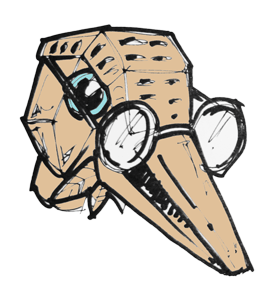
But that was then.  These days things are more relaxed.  Sam Hawksmoor's excellent The Repossession uses swearing sparingly and effectively, as do many other book too numerous to list.  It enhances tension, defines emotion and character, and isn't a block to getting published, yet I still chose to invent a whole range of frustrations and insults for Springpunk.  People are cog-heads, spring-brains and in extreme cases spring-faced cog-winders.  And if you are hit with a stray winding spark then you would cry 'Cogs!' without thinking.

Starbug
And what would Red Dwarf be without the insult smeg-head?  Still great, but ever so slightly less so.

Made-up swear words can be as integral a part of a future, dytopian and other-world society as the oppressive government forces, plasma sythesizing killer robots and overarching mystic prophesies.  They let readers into the sociology of the world and show how things have changed, how the trials, threats and drudgeries of life have bled into everyday speech.

So I challenge you, you fracking, smeg-brained, flapdoodling drokkers - have fun with your swearing.  It isn't gratuitous, but it can be vital!

All artwork copyright Julienne Durber 2012